
The United States has always been the world’s leading laboratory for business innovation. What happens in its cities, industries, and consumer markets often sets the direction for global business trends. Today, in 2026, the U.S. business landscape is undergoing a rapid transformation driven by three major forces: technology, efficiency, and deep changes in consumer behavior.
It is no longer just about selling more. Now, it is about selling better, faster, with lower operating costs, and with intelligent systems that allow businesses to scale without relying entirely on traditional labor.
In this new environment, trends such as delivery robots, automation, artificial intelligence (AI), the rise of dark kitchens, employee-free commerce, and predictive data use are reshaping how profitable businesses are built.
Below, we explore the main trends dominating the U.S. market and why they represent real opportunities for entrepreneurs, investors, and expanding companies.
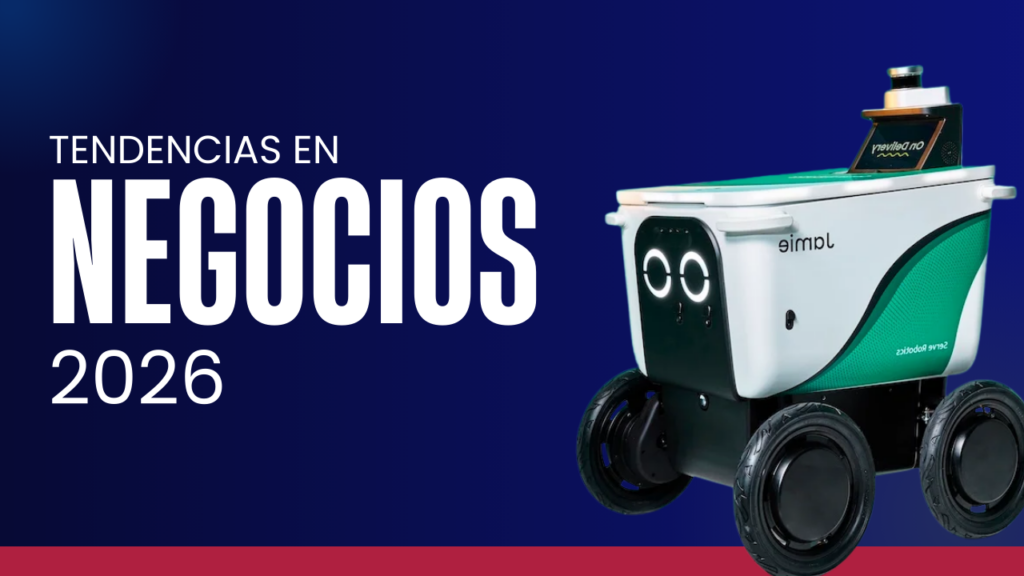
1. Delivery Robots: The Future of Delivery Is Already on the Streets
One of the most striking and increasingly common sights in cities like Los Angeles, Miami, New York, and Austin is the presence of small robots rolling along sidewalks delivering food, packages, and consumer goods.
Delivery robots are no longer a futuristic concept—they are part of everyday life.
Why are they growing so fast?
Because they solve one of the biggest challenges in the logistics and food service industries: high delivery costs.
Businesses constantly face:
Rising driver costs
Labor shortages
Traffic issues and delivery delays
Increased fees from apps like Uber Eats and DoorDash
Robots provide an efficient alternative because they:
Operate 24/7
Do not require fixed salaries
Reduce human error
Provide consistent deliveries over short distances
Where are they most profitable?
Delivery robots perform best in:
University areas
Modern residential districts
Corporate hubs
Gated communities
Cities with strong pedestrian infrastructure
Key trend: In 2026, delivery is becoming a more automated and less human-driven business, reducing costs and increasing competitiveness.
2. Business Automation: Less Labor, More Productivity
One of the strongest shifts in the U.S. is the automation of operational tasks across nearly every type of business.
Automation is no longer limited to manufacturing. Today it is being implemented in:
Restaurants
Retail stores
Distribution centers
Call centers
Administrative offices
Customer service operations
Accounting and legal processes
Automation has become a competitive advantage, especially as labor costs in the U.S. continue to rise.
Real examples of automation today
Restaurants with self-service kiosks
Self-checkout stations in supermarkets
Smart inventory systems with sensors
Software that automatically schedules shifts
Order management systems requiring minimal human involvement
Why does this matter?
Because businesses that automate:
Reduce fixed costs
Minimize errors
Scale faster
Depend less on human talent
In a country where hiring can be expensive and complex, automation has become a survival strategy.
3. Artificial Intelligence (AI): The New Invisible Employee
If there is one technology revolutionizing the U.S. business ecosystem, it is artificial intelligence.
AI is no longer used only for innovation—today it is used to make money, save time, and optimize decision-making.
Thousands of small and mid-sized businesses in the U.S. are currently using AI to:
Write content
Create ads and marketing campaigns
Analyze sales data
Predict consumer behavior
Automate responses on WhatsApp, email, and social media
Build commercial strategies
Detect fraud or accounting errors
AI in business: the biggest competitive advantage today
A company that uses AI gains access to:
Faster decision-making
Better interpretation of data
More organized processes
Reduced administrative costs
What once required a full marketing team can now be done with:
one entrepreneur
an AI tool
an automated sales system
This is creating a new generation of “lean” businesses—highly profitable and scalable.
4. Dark Kitchens: The Boom of Restaurants Without Dining Rooms
Dark kitchens (also known as ghost kitchens) have become one of the most profitable business models in the U.S. food industry.
This model involves operating a restaurant without tables, without in-person service, and without a traditional commercial dining space. Sales are made 100% through delivery.
Why are they growing so fast?
Because they eliminate the most expensive costs of a traditional restaurant:
premium location rent
interior design and décor
wait staff
customer-area maintenance
Instead, investment focuses on:
efficient kitchen operations
fast production
digital marketing
visibility on delivery apps
The evolution: Multi-brand kitchens
A powerful trend is that one kitchen can operate multiple brands simultaneously, for example:
burgers
tacos
healthy meals
bowls
Asian food
desserts
All from the same location.
This allows businesses to:
diversify revenue
optimize ingredients
reduce waste
increase average order value
5. Robots and Automation in Restaurants: The Kitchens of the Future
Beyond robotic delivery, the restaurant industry in the U.S. is now integrating robots directly into kitchen operations.
Automated systems already exist that:
prepare burgers
cook fries
make coffee
mix beverages
serve ice cream
assemble bowls
What problem do they solve?
The biggest challenge in the U.S. restaurant sector is employee turnover and labor cost.
Robots solve:
staffing shortages
recipe inconsistency
slow production
portion errors
They also improve something essential: the customer experience, because everything becomes faster.
6. Autonomous Retail: Stores Without Cashiers or Employees
It is increasingly common in the U.S. to find retail stores operating with minimal staff—or none at all.
This model is driven by:
smart cameras
motion sensors
automated payment systems
product recognition technology
mobile apps
Clear examples
“grab and go” stores
automated mini-markets
snack stations in corporate buildings
advanced vending machines
Advantages of automated retail
operates 24/7
reduces internal theft
lowers payroll expenses
delivers a fast, modern shopping experience
This is especially attractive in cities where consumers value speed more than human interaction.
7. Health, Wellness, and Longevity: The New Multi-Billion Dollar Industry
One major trend in the U.S. is the growing obsession with preventive health and longevity.
It is no longer just about gyms. American consumers are investing more than ever in:
supplements
hormone therapy
weight loss clinics
biohacking
functional medicine
anti-aging treatments
IV therapy (intravenous vitamins)
health monitoring devices
Why will this industry keep growing?
Because the market is aging while also becoming more health-conscious.
And because health has become a status symbol.
In 2026, “being healthy” is part of social and professional identity.
8. Subscription-Based Businesses: The Most Stable Revenue Model
One of the strongest trends is the growth of subscription-based business models.
Consumers in the U.S. pay monthly fees for:
healthy meals
coffee
clothing
hygiene products
snacks
supplements
software
education and coaching memberships
Why is this model so powerful?
Because it creates recurring and predictable income.
A subscription business does not depend on selling from scratch every day.
The customer joins once… and pays every month.
This creates stability and makes scaling easier.
9. Modern Franchises: Automated, Digital, and Low-Risk
The U.S. is the land of franchises. But in 2026, the concept is evolving.
The most successful franchises today are:
small
automated
digital
built on simple processes
operated with fewer employees
Growing franchise industries include
smart vending machines
automated laundromats
boutique fitness
cleaning services
health and aesthetic businesses
fast casual food
technology education centers
Franchises are attracting foreign investors because they offer:
a proven model
operational support
structured systems
scalability
10. AI + Marketing: Smarter Advertising at a Lower Cost
Another dominant trend in the U.S. is the use of AI in marketing.
Businesses can now create hyper-targeted campaigns using:
behavioral data
automated remarketing
purchase prediction
personalized content based on user profiles
Advertising is no longer based on intuition.
It is based on data.
Brands that master AI are achieving:
lower cost per lead
higher conversion rates
more sales with less budget
11. Legal and Immigration Services: More Demand, More Competition
The U.S. remains the top destination for immigrant investors, entrepreneurs, and skilled professionals.
This has created booming demand in sectors such as:
immigration attorneys
business consultants
EB-1, EB-2 NIW, and E-2 visa preparation
accounting services for foreign nationals
LLC and corporation setup consulting
But competition has also increased. Today, the firms that win are the ones that:
have strong digital presence
educate clients through content
use automation and AI
build trust through social media and online platforms
12. Businesses for Immigrants and the Latino Community: A Massive Market
The Latino community is one of the most powerful economic drivers in the U.S.
In 2026, businesses targeting Latinos continue to grow in areas such as:
financial services
insurance
healthcare
education
real estate
cultural products
specialized food businesses
Latinos buy, invest, build businesses, and create companies at an impressive pace.
This represents a major opportunity for those who understand the bicultural market.
Conclusion: The Future of Business in the U.S. Is Automated, Intelligent, and Scalable
In 2026, the U.S. market is rewarding businesses that can:
✅ operate efficiently
✅ reduce labor costs
✅ automate processes
✅ use AI as a strategic tool
✅ adapt to fast-changing consumer expectations
✅ scale quickly
Delivery robots, dark kitchens, autonomous retail, and artificial intelligence are not a trend—they are the natural evolution of an economy that demands speed, profitability, and optimization.
For entrepreneurs and investors, the message is clear:
those who understand these trends early will position themselves in industries that will dominate the next decade.