
A business plan for E-2, L-1, EB-5 visas is often the document that ties your entire case together. It shows an immigration officer what your company does, how the investment is being used, and why the project makes sense under the visa category you chose.
If you plan to invest in, launch, or expand a company in the United States, you have probably been told you "need a solid business plan." But what does solid mean in an immigration context? And is the plan for an E-2 treaty investor the same as the one for an L-1 new office or an EB-5 petition?
The short answer: an immigration business plan cannot guarantee a visa approval, but it can help demonstrate that your business is real, viable, and consistent with the criteria of the category you are applying under. Each visa asks different questions, so the plan must be tailored to the category and to your profile.
This guide covers what a professional plan should include, how expectations differ across E-2, L-1, and EB-5, how financial projections and job creation are evaluated, and the mistakes that commonly lead to a Request for Evidence (RFE).
"An immigration business plan is not written to impress a lender. It is written to answer, with evidence, the questions the officer will ask."
Why the business plan matters in an investor or business visa
In business-based visa categories, the officer is not only evaluating you. They are evaluating the enterprise you will run, how it will operate, and whether it fits the legal criteria.
The business plan is usually where that story is told in an organized way: market, operations, staffing, investment, financials, and expected growth.
When a plan is vague, generic, or contradicts other documents, it raises questions. When the record does not establish eligibility, USCIS may issue a Request for Evidence under its Policy Manual. In consular E-2 cases, those questions typically surface at the interview or as a request for additional documents.
Legal requirement, official guidance, or best practice?
It helps to separate three ideas that often get blended together:
- Legal requirement: for EB-5, the regulations expressly require a "comprehensive" business plan when a new commercial enterprise must show job creation.
- Official guidance: for E-2, the State Department's consular guidance lists five-year financial projections supported by a thorough business plan as useful evidence for new enterprises.
- Best practice: for an L-1 new office, no rule literally says "submit a business plan," but a well-built plan is usually the clearest way to prove what the regulation does require.
An immigration business plan is not a standard business plan
A traditional business plan is designed to raise capital. It highlights upside, sells the vision, and often leads with the best-case scenario.
An immigration business plan has a different job: meeting the applicable immigration criteria with verifiable information. It must be clear to someone outside your industry who reviews many similar cases.
Investor-facing plan
Persuades banks or investors. Focuses on upside and returns for third parties.
Immigration-focused plan
Demonstrates viability, structure, investment, operations, and hiring as required by the visa. Focuses on consistency and evidence.
That is why recycled templates or plans written for another purpose often fall short. They may be commercially sound but still miss what the officer needs to verify.
Structure: 7 elements of a business plan for E-2, L-1, EB-5 visas
There is no single official format. Still, a strong plan for any of these three categories generally covers the following seven sections, with more or less depth depending on the visa.
1. Executive summary
What the company does, where it operates, how much is being invested, who will direct it, and what it expects to achieve. It should be readable in two minutes and match the rest of the file exactly.
2. Company description and legal structure
Entity type, state of formation, ownership percentages, location, and, for L-1, the qualifying relationship with the foreign company (parent, branch, subsidiary, or affiliate).
3. Market analysis
Industry, target customers, local competitors, and competitive advantage. Local, specific data is far more persuasive than broad national statistics.
4. Operations plan
Premises, suppliers, processes, permits and licenses, and a launch timeline. This is where you show the business is real and operating, not just an idea.
5. Management and personnel
Current and projected org chart, the applicant's role, planned hires, job duties, and wages. This section carries extra weight in L-1 and EB-5 cases.
6. Investment and use of funds
How much is invested, where each dollar goes, and what has already been committed. It must match the contracts, invoices, and bank records in the file.
7. Financial projections
Revenue, costs, profit, cash flow, and projected payroll, with clearly explained assumptions. Usually five years, although the time horizon and emphasis vary by visa.
E-2 vs. L-1 vs. EB-5: how the business plan changes
The outline of a business plan for E-2, L-1, EB-5 visas may look similar, but each category asks a different core question. Treating all three the same is one of the most expensive mistakes an applicant can make.
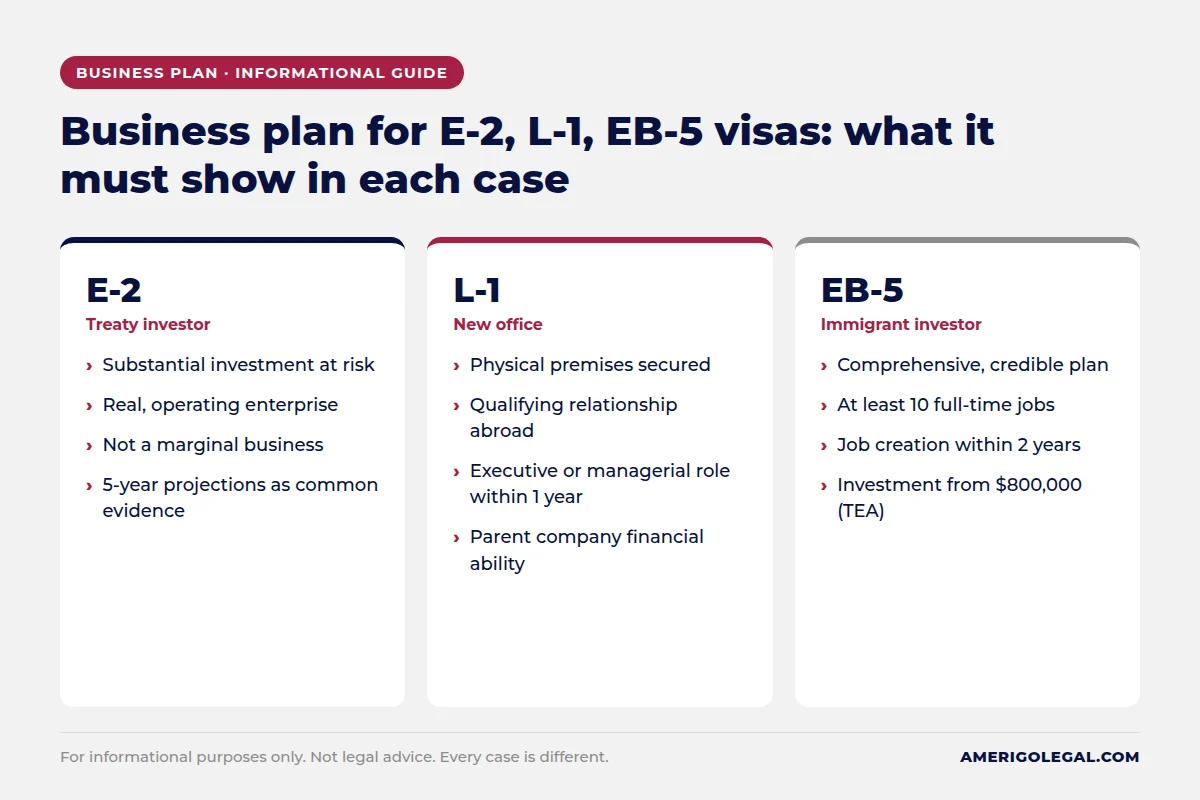
| Factor | E-2 visa | L-1 visa (new office) | EB-5 visa |
|---|---|---|---|
| What the plan must show | Substantial investment in a real, operating, non-marginal enterprise | The office can support an executive or managerial role within one year | The enterprise will need at least 10 full-time qualifying employees |
| Is it mandatory? | Not expressly required by regulation, but standard and recommended evidence | Not expressly required; used to prove new-office requirements | Yes, a comprehensive plan for new enterprises under 8 CFR 204.6(j)(4)(i)(B) |
| Job creation | No minimum number; hiring helps show the business is not marginal | Staff that lets the manager delegate day-to-day operations | Minimum of 10 full-time jobs per investor |
| Key time frame | Future capacity generally realizable within 5 years | First year after approval | Job creation within a 2-year period |
E-2 visa business plan
Under the State Department's 9 FAM 402.9 guidance, the investment must be substantial, at risk, and irrevocably committed, and the enterprise cannot be marginal. A marginal enterprise lacks the present or future capacity to generate more than a minimal living for the investor and family, unless it has a significant economic impact.
Your plan should show how the business clears that threshold. For the broader requirements, see our E-2 treaty investor visa page and our article on how poor business structure can hurt an E-2 case.
L-1 visa business plan
When a foreign company opens a new U.S. office, 8 CFR 214.2(l)(3)(v) requires evidence that sufficient physical premises have been secured and that the operation will support an executive or managerial position within one year. The size of the U.S. investment, the organizational structure, and the foreign entity's financial ability are all considered.
Initial new-office approvals are limited to a period of up to one year, according to the USCIS Policy Manual. That makes realism essential: what you project becomes the benchmark for the extension. Learn more on our L-1 visa page.
EB-5 business plan
For EB-5, the plan is central. It must be comprehensive and credible and show that, due to the nature and projected size of the enterprise, the need for at least 10 qualifying employees will arise within the next two years, as explained in the USCIS Policy Manual on EB-5.
For petitions filed on or after March 15, 2022, the minimum investment is $1,050,000, or $800,000 in a targeted employment area (TEA) or infrastructure project. These amounts are scheduled to adjust automatically on January 1, 2027, so confirm the current figure before investing. See our EB-5 visa page for more.
Five-year financial projections and hiring plan
Projections are the numerical backbone of any business plan for E-2, L-1, EB-5 visas, but they are not read the same way in every category.
E-2 visa financial projections
For E-2, five-year projections help show that the company has the future capacity to generate more than a minimal living or to make a significant economic contribution. Optimism is not enough: projections should explain where revenue comes from, what costs are assumed, and when break-even is expected.
E-2 visa job creation
The E-2 has no minimum job-creation requirement. Even so, a realistic hiring plan, with positions, duties, wages, and timing, is one of the clearest ways to show the business is not marginal.
Staffing for L-1 and EB-5
- L-1: the staffing plan must show that the transferred executive or manager will not end up performing routine operational tasks.
- EB-5: the 10-job threshold is a legal requirement, and the plan must explain how and when those positions will be created.
Best practices for projections: explain every assumption, use conservative scenarios, tie payroll to the org chart, and confirm that the numbers match the actual investment and the contracts in the file.
Common business plan mistakes that can trigger an RFE
These are some of the issues that most often weaken a business plan for E-2, L-1, EB-5 visa filings:
- Using a generic template. A plan that could describe any company proves nothing about yours.
- Unsupported projections. 300% growth with no stated assumptions invites scrutiny.
- Contradictions with other documents. Different amounts, dates, titles, or addresses across the plan, contracts, and forms.
- Ignoring the category. An E-2-style plan that never addresses the managerial role in an L-1, or one that skips the 10 jobs in an EB-5.
- Failing to show committed funds. For E-2, money sitting in an account without a real commitment is generally not an investment at risk.
- Leaving out source of funds. The plan must be consistent with evidence of the lawful source of capital.
- Describing a marginal operation. A business that would only support the investor may not meet E-2 criteria.
If you are unsure whether prior experience matters, read can you get an E-2 visa without prior business experience?
Consistency across the plan, the investment, and your immigration strategy
A strong file tells one story. Your plan should match:
- Formation documents and ownership structure.
- Lease, purchase, or franchise agreements.
- Wire transfers, invoices, and bank statements proving the investment.
- Source-of-funds evidence.
- Your resume and the role you will hold.
- Immigration forms and the answers you will give at the interview.
A business plan for E-2, L-1, EB-5 visas should also reflect your profile: your experience, your nationality (E-2 requires citizenship of a treaty country), available capital, and long-term goals, such as a future path to a green card.
Important: no strategy or document can guarantee a visa approval. The business plan is one piece of evidence, weighed together with the entire file and the standards applied by each officer and consulate.
When professional guidance may make sense
Consider working with an immigration legal team if:
- You are not sure whether your project fits an E-2, L-1, or EB-5 best.
- You are buying an existing business or franchise and need to evaluate the structure.
- Your investment is close to the line of what may be considered substantial.
- Your foreign company is small and you want to open a new U.S. office.
- You received an RFE or a denial and want to understand what went wrong.
Not sure which visa fits you? Start with our free which visa is right for you quiz, explore visas for investors and entrepreneurs, or read about non-traditional businesses for E-2 visa investors.
Frequently asked questions about immigration business plans
Does a business plan guarantee approval of my E-2, L-1, or EB-5 visa?
No. The plan is an important piece of evidence, but the decision depends on the full record, the category's requirements, and the officer's review. No document guarantees an outcome.
Is a business plan required for the E-2 visa?
No regulation expressly requires one, but State Department guidance lists five-year projections supported by a business plan as useful evidence for new enterprises. Many consulates also publish their own document checklists.
How many years should the financial projections cover?
Five years is the common standard for E-2. For EB-5, the focus is job creation within two years, and for an L-1 new office, what happens during the first year.
How many jobs does my business need to create?
It depends on the visa. EB-5 requires at least 10 full-time jobs per investor. E-2 sets no minimum, although hiring helps show the business is not marginal. For L-1, staffing should allow the manager to perform managerial duties.
Can I use the same business plan for different visas?
It is not recommended. Each category addresses different criteria, so the plan should be tailored to the specific visa and your profile as an applicant.
What happens if my plan has errors or inconsistencies?
It can lead to an RFE, additional questions at the interview, or otherwise weaken the case. That is why the plan must be cross-checked against every other document.
Are you considering investing in, launching, or expanding a business in the United States?
Schedule a strategy consultation with Amerigo Legal to review your project and learn which immigration options may apply to your situation.
Request your free case assessment Personalized assessment · 100% confidential · Response within 24 business hoursOfficial sources reviewed (September 2026): USCIS – E-2 Treaty Investors · 9 FAM 402.9 · USCIS – L-1A · USCIS – EB-5.
This content is for informational purposes only and does not constitute legal advice. Every immigration case must be evaluated individually, and no firm can guarantee visa approval. Every case is different. Past results do not guarantee future outcomes.