
Many investors assume the E-2 is only for restaurants, franchises, and retail stores. In reality, non-traditional businesses for E-2 visa investors, such as tech startups, B2B service firms, consulting practices, and logistics companies, can also be part of a sound E-2 strategy when they meet the applicable criteria.
What matters is not the industry but how the business is built: how much you invest and in what, who directs it, what economic activity it generates, and how it is expected to grow in the United States.
The short answer: a non-traditional business can be considered for an E-2 visa, but no type of company qualifies automatically. Eligibility depends on the specific characteristics of the business, the amount and structure of the investment, your nationality, and the other E-2 requirements.
Below you will find examples of business models that may fit an E-2 strategy, the legal concepts to understand before choosing one, the most common evaluation mistakes, and answers to the questions investors ask us most often.
"The E-2 does not reward a particular industry. It asks whether your investment builds a real, active company with the capacity to grow."
Beyond restaurants and franchises
Traditional businesses are popular for E-2 cases for a practical reason: they come with visible assets (a storefront, equipment, inventory), proven models, and costs that are easy to document. That makes the investment easier to prove.
But the rules do not require any specific industry. According to USCIS, the enterprise must be a real, active, and operating commercial undertaking that produces goods or services for profit. That leaves room for service-based, knowledge-based, and technology-driven models.
For context on where the market is heading, see our article on U.S. business trends for 2026.
Key E-2 visa requirements to understand before choosing a business
The State Department's 9 FAM 402.9 guidance sets out the standards consular officers apply. These are the ones that matter most for a non-traditional business:
Substantial investment and the proportionality test
There is no fixed minimum dollar amount. Officers apply a proportionality test that compares your investment to the total cost of establishing or buying that type of business. The less expensive the business, the higher the percentage you are generally expected to cover. For asset-light service companies, the structure of the investment deserves extra attention.
Funds at risk and irrevocably committed
Capital must be irrevocably committed and subject to commercial risk. Money sitting in a bank account with no concrete use, or a mere intent to invest, is usually not enough.
A real and operating enterprise
The business must be an active commercial undertaking. Passive or speculative investments, such as undeveloped land or stocks held without the intent to direct the enterprise, do not qualify.
Develop and direct
The investor must own at least 50% of the enterprise or have operational control through a managerial position or another corporate device.
Not a marginal enterprise
A marginal enterprise lacks the present or future capacity to generate more than a minimal living for the investor and family. A business with the capacity to make a significant economic contribution is not considered marginal. That future capacity should generally be realizable within five years of starting normal operations.
Lawful source of funds
You must be able to document where the capital came from: savings, sale of property, business profits, inheritance, or other legitimate sources.
What makes a non-traditional business a viable E-2 candidate?
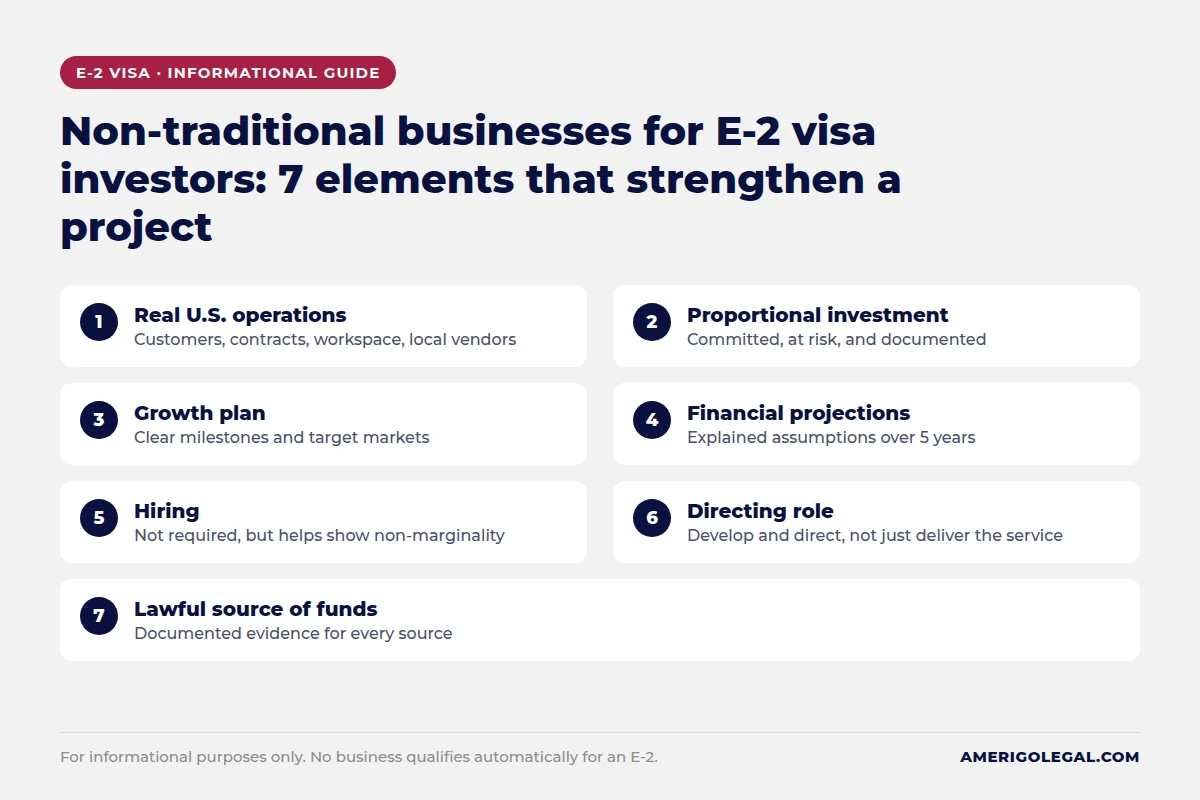
In practice, a non-traditional E-2 investor business becomes stronger when it can document these elements:
- Real U.S. operations: customers, contracts, office or workspace, local accounts and vendors, not just a website.
- A concrete, proportional investment: equipment, software, licenses, build-out, inventory, or reasonable working capital, backed by invoices and contracts.
- A clear growth plan: milestones, targets, and U.S. markets.
- Well-supported financial projections: revenue and costs with explained assumptions, typically over five years.
- Job creation where relevant: the E-2 has no minimum number, but hiring helps show the business is not marginal.
- A directing role for the investor: developing and managing the company, not just personally delivering the service.
- Genuine commercial risk: the capital can be lost if the business fails.
Ideally, all of this is presented in a business plan tailored to the visa. We cover that in detail in our guide to the business plan for E-2, L-1, and EB-5 visas.
12 non-traditional businesses for E-2 visa investors to explore
The examples below are business models that may be compatible with an E-2 strategy. None qualifies on its own; everything depends on how each case is structured.
1. Technology companies
Software development, SaaS, or AI solutions with a team, customers, and operations in the U.S.
2. B2B services
Outsourcing, back-office support, medical billing, or payroll services for U.S. businesses.
3. Specialized agencies
Digital marketing, SEO, advertising, or branding agencies with local clients and a growing team.
4. Consulting firms
Business, financial, or international expansion consulting structured as a firm, not freelance work.
5. Professional services
Architecture, engineering, or design firms, subject to any required state licensing.
6. Digital businesses with real operations
E-commerce with U.S. warehousing or fulfillment, local suppliers, and staff.
7. Logistics
Freight brokerage, last-mile delivery, warehousing, or import and distribution.
8. Specialized trade services
Industrial maintenance, solar installation, renovation, or technical field services.
9. Creative businesses
Video production, photography studios, animation, or event production.
10. Education and training
Language schools, technical training, or corporate programs, with any applicable approvals.
11. Services for specialized industries
Support services for construction, healthcare, real estate, or maritime sectors, subject to regulation.
12. Innovative or niche models
Pet services, commercial drones, corporate wellness, or specialty travel.
Important: the same idea can be viable or not depending on its structure. A digital business run entirely from abroad, or a consulting practice where the investor is the only service provider, may face more scrutiny than a project with operations, clients, and staff in the United States.
A practical example: same industry, different outcomes
Picture two investors who want to open a digital marketing agency in Miami.
Project A
The investor wires capital into the company account but signs no contracts and buys no equipment. The plan is to work alone from home, serving the same clients from their home country. There is no hiring plan.
Project B
The investor leases an office, buys equipment and software licenses, signs contracts with local clients, plans to hire three employees within two years, and submits five-year financial projections with clear assumptions.
Both are in the same industry. Project B, however, shows far more clearly a committed investment, an operating enterprise, and growth capacity beyond a minimal living. That is how officers tend to look at non-traditional businesses for E-2 visa cases: structure matters more than the idea itself. This example is illustrative only; every case must be evaluated individually.
5 mistakes when evaluating a business for an E-2 visa
- Choosing a trend instead of a fit. The business should make sense for your background, capital, and life plans in the U.S. If experience is a concern, read can you get an E-2 visa without prior business experience?
- Underestimating proportionality. In asset-light service businesses, a low investment may not be considered substantial relative to the cost of the project.
- Confusing self-employment with an enterprise. If the business only generates income for you, it may be considered marginal.
- Not proving U.S. operations. Clients, contracts, and expenses abroad do not replace a real operation in the United States.
- Overlooking licenses and regulations. Some activities require state or federal permits. Failing to plan for them weakens the project.
Before you invest: a quick checklist
Before committing capital to non-traditional businesses for E-2 visa purposes, ask yourself:
- Does your country of citizenship have an active E-2 treaty with the United States?
- Is the investment proportional to the real cost of establishing this business?
- Can you document the lawful source of all funds?
- Will the business have real operations, customers, and expenses in the U.S.?
- Will your role be to develop and direct the company?
- Do you have well-supported financial projections and a growth plan?
- Do you plan to hire staff over the next few years?
Not sure the E-2 is your best option? Take our free which visa is right for you quiz, review the E-2 treaty investor visa requirements, or browse our immigration FAQ.
Frequently asked questions about non-traditional E-2 businesses
Can an online business qualify for an E-2 visa?
It may be considered if it has real U.S. operations, a committed investment, and growth capacity. A business run only from abroad or without a local structure is likely to face more questions.
Can a consulting firm be an E-2 visa business?
It can, as long as it is structured as a company with investment, operations, and growth projections, rather than an activity where the investor simply provides services personally.
How much should I invest in a service-based business?
There is no official minimum. The investment must be substantial in proportion to the cost of establishing that specific business and sufficient to ensure it can be successfully developed.
Do I need to hire employees for a non-traditional E-2 business?
The E-2 has no minimum job requirement. However, a realistic hiring plan helps demonstrate that the enterprise is not marginal.
Can I run my E-2 business from home?
It depends on the business and how operations are documented. Generally, commercial space and visible operations make it easier to show the enterprise is real and active. This is best assessed case by case.
Is there an official list of businesses that qualify for the E-2?
No. Neither USCIS nor the State Department publishes a list of approved industries. Each investment and enterprise is evaluated on its own characteristics.
Have a different kind of business idea and wonder if it could fit an E-2 strategy?
Review your business project with the Amerigo Legal team and learn which immigration options may apply to your situation.
Request your free case assessment Personalized assessment · 100% confidential · Response within 24 business hoursOfficial sources reviewed (September 2026): USCIS – E-2 Treaty Investors · 9 FAM 402.9 · Department of State – Treaty Trader and Investor Visa.
This content is for informational purposes only and does not constitute legal advice. Every immigration case must be evaluated individually, and no firm can guarantee visa approval. Every case is different. Past results do not guarantee future outcomes.