
Business structure in the US: building financial prosperity from day one
If you plan to invest, open a company or expand your business, the business structure in the US you choose shapes how you pay taxes, how you protect your assets and, in many cases, how your immigration case is presented. That is why Session 2 of our Soft Landing Course is dedicated to financial prosperity and business structure.
The short answer: there is no single “best” structure. An LLC, a C-Corp or a branch office can be the right or wrong call depending on your goal, your visa and your tax situation. What matters is making the decision with good information, before you form the company and move your capital.
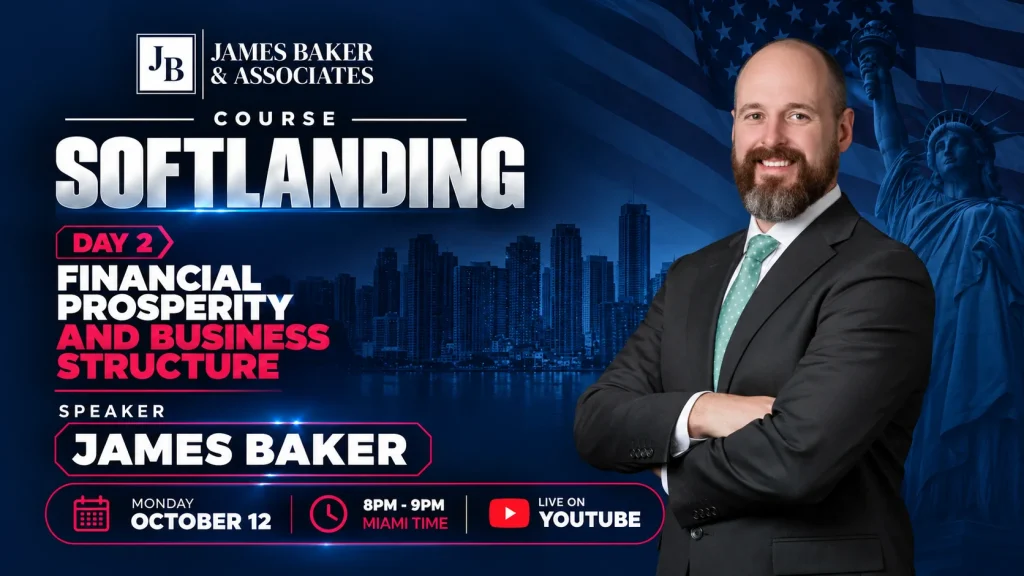
Amerigo Legal Group Soft Landing Course · Session 2: Financial Prosperity and Business Structure, with James Baker (James Baker & Associates).
In this article you'll find what Session 2 covers, the questions to ask yourself before choosing a structure, and how that decision connects with visas such as the E-2, L-1 or EB-5.
A well-structured company doesn't just avoid surprises: it also tells the story of your investment more clearly.
What Session 2 of the Soft Landing Course covers
A soft landing is exactly what it sounds like: arriving in the United States with a plan, not a series of improvised decisions. Our course supports Latin American entrepreneurs, executives and investors through the choices that make that landing smooth.
In Session 1, our CEO Joaquín Rosales covered strategic protection and legal empowerment. In Session 2, our guest speaker James Baker, of James Baker & Associates, tackled the other side of the landing: your financial foundation and the structure of your business.
The session streamed live on YouTube on Monday, October 12, 2026, and you can watch it in full above. Key topics include:
- How to build a solid financial foundation when you arrive in the US.
- How to structure your business for sustainable growth.
- Which opportunities open up when you expand into the US market, and how to pursue them in an orderly way.
Why business structure in the US matters so much
Many investors form their company online in a few minutes, only to find out later that the structure doesn't fit their plan. Fixing it can cost time and money and, in some cases, complicate an immigration case.
Your company's structure affects at least four areas:
- Taxes: according to the IRS, your business structure determines which income tax return form you file.
- Liability: some structures separate your personal assets from business debts; others don't.
- Ownership and partners: who owns what percentage and how decisions are made.
- Your immigration case: several investment and trade visas look closely at who owns the company and how it relates to your business back home.
If you're still deciding which path fits you, a well-prepared business plan for an E-2, L-1 or EB-5 visa is a good place to start organizing your numbers.
Business structure options in the US
The Small Business Administration (SBA) outlines several structures. These are the ones that come up most often for foreign investors:
LLC
Flexible and simple to manage. Separates your personal assets from the business and allows different tax treatments. Popular with entrepreneurs.
C-Corporation
The traditional corporate structure. Useful if you plan to bring in investors or grow with several partners. Taxed at the company level.
Branch or subsidiary
If you already own a company abroad and want to open US operations, the relationship between both entities is key (for example, for the L-1).
S-Corporation
Restricts who can be a shareholder, so many nonresident foreigners cannot use it. Review this with your accountant.
Beyond the entity type, you'll also choose a state of formation. Florida, for example, handles business registrations through Sunbiz, the Division of Corporations of the Department of State. The right state is usually the one where you will actually operate.
Business structure in the US and your visa
Your business structure and your immigration strategy should be designed together. Some general examples:
| Visa | What is usually reviewed about the company |
|---|---|
| E-2 Visa | That the business is real and operating, that the investment is substantial, and that treaty-country nationals own at least 50% of it. |
| L-1 Visa | The qualifying relationship between your foreign company and the US entity (parent, branch, subsidiary or affiliate). |
| EB-5 Visa | The lawful source of funds, the amount invested and job creation under the program. |
| E-1 Visa | Substantial and ongoing trade between the US and the treaty country. |
Requirements, amounts and timelines change. Always check the official source, such as the USCIS E-2 Treaty Investors page, and have your case reviewed by an immigration attorney.
Financial prosperity: habits from day one
Session 2 drives home a simple but decisive point: financial prosperity is built with discipline. A few habits worth having from the start:
- Keep personal and business finances separate, with different bank accounts.
- Document the source and movement of your capital. In investment cases, tracing the funds is often central to the case.
- Work with a US accountant who understands international clients.
- Build your financial history in the US gradually and responsibly.
- Project realistically: revenue, expenses, taxes and working capital for the first months.
Important: no structure or strategy can guarantee visa approval. Every case is evaluated individually, and tax decisions should be reviewed with a qualified accountant or tax advisor.
Before you form your company: checklist
Use this list to see whether you're ready to choose your business structure in the US:
- You know which visa or immigration path fits your profile.
- You've defined who the partners are and each one's ownership percentage.
- You know whether your US company will be related to a company in your home country.
- You can document the source of your capital.
- You've chosen the state where you will actually operate.
- You've discussed the tax implications with an accountant.
- You've reviewed your plan with an immigration attorney before signing or transferring funds.
Not sure which visa fits you? Take our free quiz: which visa is right for you?
Watch the full Soft Landing Course
Frequently asked questions
What is a business structure in the US?
It's the legal form your business takes: LLC, corporation, partnership, branch and others. It determines how the business is taxed, who is liable for its debts and how ownership is divided.
Which structure is best for a foreign investor?
It depends on your goal, your visa and your tax situation. Many investors use an LLC or a C-Corp, but the decision should be made case by case with your attorney and accountant.
Does my company's structure affect my visa?
Yes. Visas like the E-2, E-1 or L-1 review who owns the company and how it relates to your business abroad. A poorly planned structure can weaken the case.
Can I change the structure later?
Often yes, but it may carry tax and legal costs and affect an immigration process that is underway. It's better to get it right from the start.
Where can I watch Session 2 of the Soft Landing Course?
It's available for free on the Amerigo Legal Group YouTube channel and embedded at the top of this article.
Want to know which structure and visa fit your profile?
Review your case with our team and define your strategy before you invest.
Request your free case assessment Personalized assessment · 100% confidential · Response within 24 business hoursMore questions? Visit our FAQ, explore our visas for investors and entrepreneurs, or watch more of our videos.
Official sources consulted: SBA – Choose a business structure · IRS – Business structures · USCIS – E-2 Treaty Investors (accessed October 2026).
This content is for informational purposes only and does not constitute legal, accounting or tax advice. Every immigration case must be evaluated individually, and no firm can guarantee visa approval. Guest speakers' opinions are their own.