
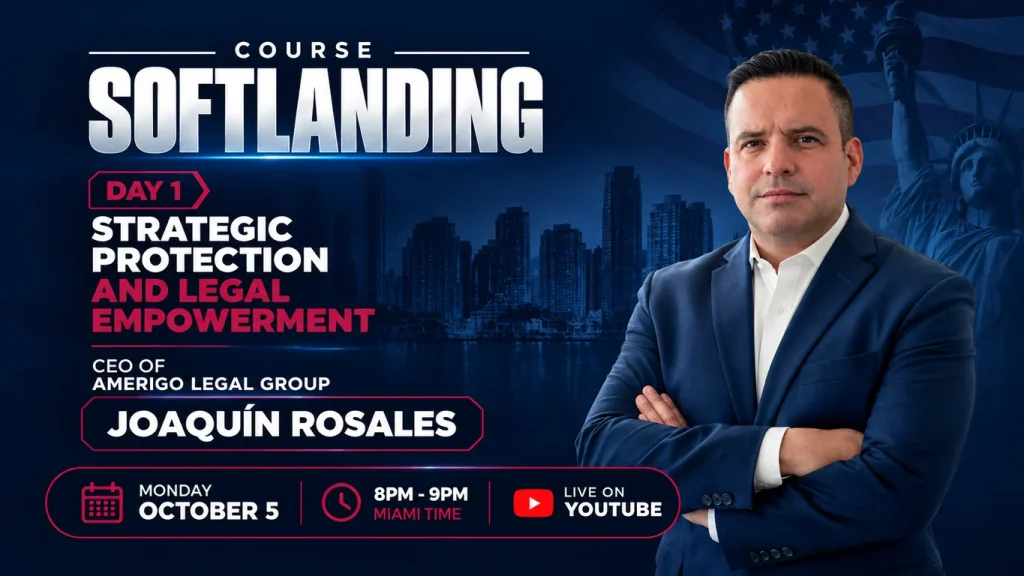
A solid legal strategy to immigrate to the US is what separates an organized process from one full of improvisation, denials and lost time. That is why we opened our Soft Landing course with a first session dedicated entirely to this topic: how to treat your move as a project before you choose a visa.
If you are a business owner, executive, investor or professional considering a move with your family, this session is your starting point. Below, we explain what it covers, why it matters and which questions you should answer before filing any application.
The short answer: immigrating to the United States does not start with a form, it starts with an assessment. Defining your goal, your profile, your immigration path and your family's timeline before you apply reduces mistakes and helps you make informed decisions.
Amerigo Legal Group Soft Landing course · Session 1 (in Spanish): legal strategy to immigrate to the US.
In this article you will learn what the Soft Landing course is, why a legal strategy to immigrate to the US is essential, seven key points to review before applying, the most common immigration paths for business profiles, and a checklist for your next step.
Moving to the United States is not just paperwork: it is a life project that deserves a strategy.
What is the Soft Landing course?
In business, a soft landing describes the orderly entry of a company or a person into a new market, with the structure, permits and planning needed so the change does not become a crisis.
Our Soft Landing course applies that idea to immigration. It is a video series on our YouTube channel designed for Latin American business owners, executives, investors and professionals who want to understand how to plan their arrival in the United States legally and in an organized way. The sessions are recorded in Spanish.
Session 1 focuses on legal strategy: the framework that helps you decide which path to take before you commit time and capital. You can watch it above and explore more content in our video library.

Why you need a legal strategy to immigrate to the US
The US immigration system has dozens of visa categories, each with its own requirements, timelines and consequences. Choosing the option that “sounds best,” or the one that worked for someone you know, is one of the most common mistakes.
A legal strategy to immigrate to the US helps you avoid risks such as:
- Choosing a visa that does not fit your profile and receiving a denial that stays on your immigration record.
- Using a tourist visa with the intent to stay. The law presumes that nonimmigrant visa applicants intend to immigrate unless they prove otherwise (section 214(b) of the Immigration and Nationality Act). See the Department of State's visitor visa page.
- Overstaying your authorized stay. Accruing unlawful presence can trigger 3- or 10-year bars to re-entry, depending on the length of time, as explained on travel.state.gov.
- Investing before your immigration path is clear, using structures that later fail to meet the requirements of the visa you need.
- Leaving your family out of the plan: children close to turning 21, or spouses who need to work or study.
Strategy does not replace the requirements: it organizes them. It tells you what you need to prove, with which documents and in what order.
7 key elements of an immigration strategy
In our experience, these are the questions worth answering before you file any application:
1. Define your goal
Do you want to expand your company, invest, work or live permanently in the US? The answer determines whether a temporary visa, a green card or a combination makes sense.
2. Assess your real profile
Available capital and its source, career track record, company in your home country, achievements, nationality and immigration history. Everything counts.
3. Choose the right path
E-2, E-1, L-1, EB-5, O-1, EB-2 NIW… Each visa fits a different profile. The best option is the one your case can support with evidence.
4. Plan the sequence
Many families combine routes: a temporary visa to arrive and operate, then a path to permanent residence. Planning it from day one prevents contradictory decisions.
5. Structure your investment and company
How capital moves, who owns what and how it is documented. A strong business plan is part of the strategy, not an attachment.
6. Include your family
Spouses and children follow their own rules as dependents: age limits, work and study permissions. Review them from the start.
7. Prepare documents and timelines
Translations, certificates, financial statements, letters and consular timelines. Preparing early reduces delays and requests for additional evidence.
Answering these seven questions is the foundation of any legal strategy to immigrate to the US. If you are not sure where to start, take our free “Which visa is right for you?” quiz before booking an assessment.
Common immigration paths for business owners and professionals
Every case is evaluated individually, but these are some of the routes we analyze most often for business profiles. See the full overview on our visas for investors and entrepreneurs page.
| Visa | Who it is for | Type | Key point |
|---|---|---|---|
| E-2 | Investors from treaty countries | Nonimmigrant | Substantial investment in a real business you direct |
| E-1 | Traders from treaty countries | Nonimmigrant | Substantial trade, principally with your home country |
| L-1 | Executives, managers or specialized-knowledge staff | Nonimmigrant | Related company abroad and at least one continuous year of employment in the last three |
| EB-5 | Investors seeking a green card | Immigrant | Minimum investment set by law and job creation |
| O-1 | Individuals with extraordinary ability | Nonimmigrant | Sustained recognition in your field |
| EB-2 NIW | Professionals with projects of national interest | Immigrant | Merit and national importance of the endeavor |
Requirements, amounts and timelines can change. For example, EB-5 minimum investment amounts are set by law and published on the official USCIS EB-5 program page. Always verify current information before deciding.
Beyond the visa: your landing in the US
A legal strategy to immigrate to the US does not end with an approval. A true “soft landing” includes practical decisions that should be coordinated with your immigration plan:
- Your company: entity type, state of formation, partners and governance.
- Banking and capital flow: how to transfer and document funds in a traceable way.
- Taxes: your tax residence may change. Coordinate with a certified public accountant in both countries.
- Housing, schools and insurance: decisions that depend on your family's timeline and status.
- Maintaining status: renewals, travel and business changes that can affect your visa.
Our team focuses on the immigration side and guides you on when to bring in other advisors so every piece fits together.
Why the way your case is presented matters
Two people with similar profiles can get different outcomes depending on how their application is structured and documented. A consular officer or USCIS adjudicator only knows what you show them: your story, your investment, your experience and your plans, organized coherently.
That is why a legal strategy to immigrate to the US is built before any form is filled out: it defines which evidence is relevant, how the source of funds is explained, how your background connects to the project and how to prepare for the interview.
Important: no strategy can guarantee visa approval. What it does is reduce avoidable mistakes and present your case as strongly as possible based on your real profile.
Before you take the step: checklist
Use this list to see whether you are ready to discuss your case:
- Clear goal: you know whether you want a temporary stay, a green card or both in sequence.
- Capital identified: you know the available amount and can document its source.
- Documented track record: you have evidence of your experience, company or achievements.
- Family included: you reviewed your spouse's and children's ages, studies and plans.
- Immigration history reviewed: you know your travel history, prior visas and any denials.
- Realistic timeline: you considered consular, USCIS and preparation times.
- Session 1 watched: you reviewed the Soft Landing video and wrote down your questions.
Frequently asked questions
What is a legal strategy to immigrate to the US?
It is a plan that defines your immigration goal, the visa or combination of visas that best fits your profile, the order of steps, the documents required and the timeline, including your family. It is built before any application is filed.
Who is the Soft Landing course for?
Latin American business owners, executives, investors and professionals who are considering a move to the United States and want to understand their legal options before making investment or relocation decisions.
Can I enter as a tourist and change my visa later?
In some cases you can request a change of status inside the US, but entering on a tourist visa when you already intend to stay can create serious problems. That is why it is best to define your strategy before you travel.
What is the best visa to immigrate to the US?
There is no single best visa for everyone. The right one depends on your nationality, capital, experience, company and goals. A personalized assessment lets you compare options against your real profile.
Do I need a lawyer to define my immigration strategy?
It is not mandatory, but an immigration attorney can help you identify risks, choose the right path and prepare your evidence. Immigration decisions often have long-term consequences.
Want to know which legal strategy fits your profile?
Review your case with our team and understand your options to immigrate to the US with clarity.
Request your free case assessment Personalized assessment · 100% confidential · Response within 24 business hoursStill have questions? Visit our FAQ or read whether you can get an E-2 visa without prior business experience.
Official sources consulted: Department of State – Visitor Visa · Department of State – Visa Overstays · USCIS – EB-5 Immigrant Investor Program · USCIS – E-2 Treaty Investors.
This content is for informational purposes only and does not constitute legal advice. Every immigration case must be evaluated individually, and no firm can guarantee visa approval.