
Franchise investment in the US comes up in almost every conversation with Latin American business owners who want to expand. Is buying a franchise a smart way to start a business in America? What should you review before signing? And how does that decision connect to your visa?
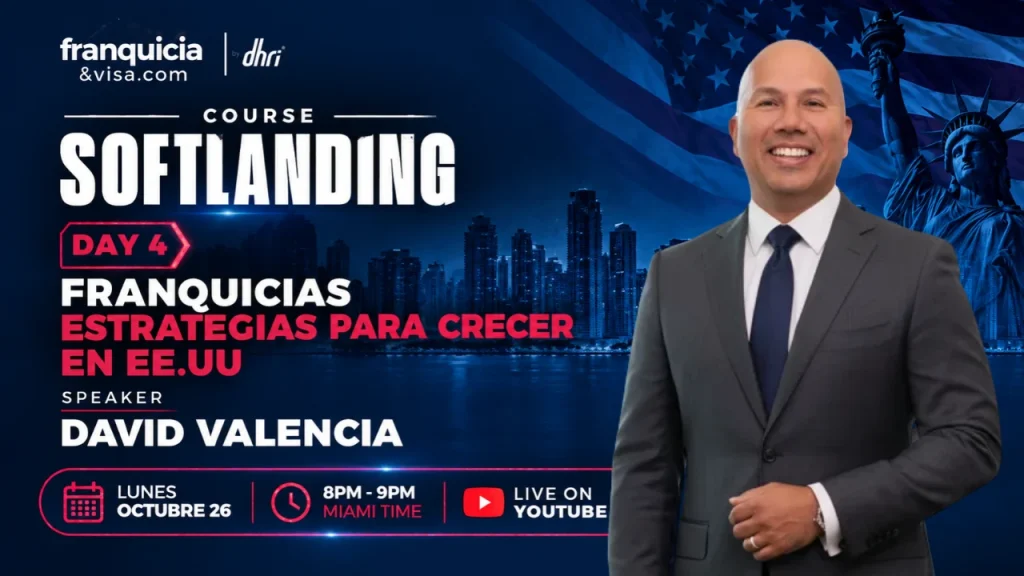
Those were the questions behind Session 4 of Amerigo Legal Group's Soft Landing course, with David Valencia, CEO of Franquicia y Visa, as our guest. If you missed it live, you can watch the full session here for free. The session was presented in Spanish.
The short answer: a franchise can be a structured way to enter the US market because it comes with a proven model, a brand and a support system. But it is not automatic or risk-free: you need to analyze costs and contract terms and, if you are pursuing a visa such as the E-2 or L-1, how the investment is structured from day one.
Amerigo Legal Group's Soft Landing course · Session 4: strategies to grow in the United States through franchises and investment, with David Valencia (CEO of Franquicia y Visa). In Spanish.
In this article you will see what the session covered, why so many investors look at franchises as an entry point, what to review before investing and how it all relates to investor visas.
A franchise is not just a business you buy: it is an expansion strategy that must fit your capital, your profile and your immigration plan.
What Session 4 of the Soft Landing course covered
The Soft Landing course is a free live series on YouTube for entrepreneurs, executives and investors planning their move to the United States. After covering legal protection in Session 1, business structure in Session 2 and leadership mindset in Session 3, the fourth session focused on a very practical question: how do you turn a business opportunity into a real expansion strategy?
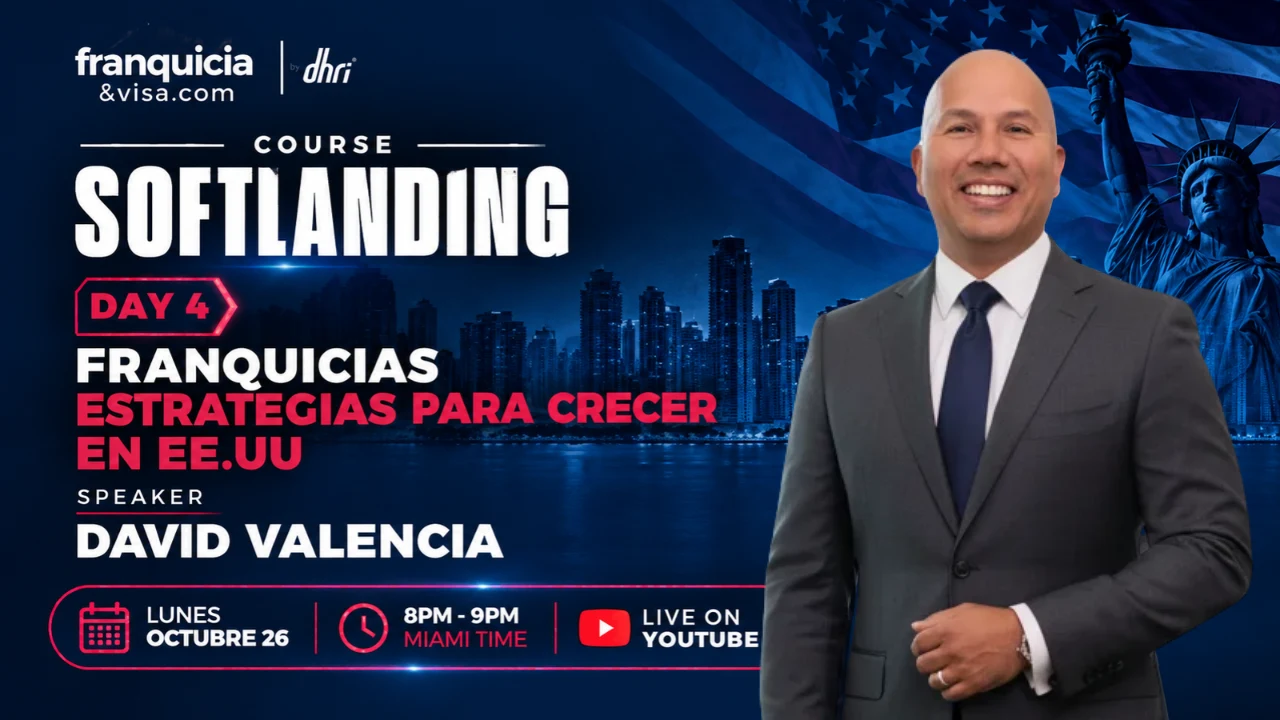
Our guest was David Valencia, CEO of Franquicia y Visa. The session aired on Monday, October 26, 2026, from 8:00 to 9:00 p.m. (Miami time), and covered:
- Investment opportunities: how to explore franchise models across different US industries.
- Strategic evaluation: what to analyze before investing, from startup costs to each brand's requirements and conditions.
- Franchises as an expansion model: the differences between buying a franchise and building an independent business.
- Visas and immigration planning: an overview of options such as the E-2 and L-1 visas, depending on the investor's profile and business structure.
- Planning for growth: how to connect business goals with a financial, corporate and immigration strategy.
Why franchises appeal to Latin American investors
Entering a new market means facing many unknowns at once: suppliers, permits, customers, employees and business culture. A franchise reduces part of that uncertainty because it offers a system that already works elsewhere.
Proven model
Defined processes, manuals and standards that shorten the learning curve.
Recognized brand
Customers already know the product or service, which matters when you have no local track record.
Training and support
Initial training and guidance from the franchisor during opening and operations.
Clearer planning
Startup costs and operations that are easier to project in a business plan.
That does not mean every franchise is a good investment or a good fit for every profile. It does give you a more structured starting point to analyze numbers, risks and timelines.
What to review before investing in a franchise
One of the session's core ideas is that this decision should be driven by information, not enthusiasm. These are the points worth reviewing carefully:
- Total investment, not just the entry fee. Beyond the franchise fee, consider the location, build-out, equipment, inventory, working capital and ongoing royalties.
- The Franchise Disclosure Document (FDD). In the US, the FTC Franchise Rule requires franchisors to provide a disclosure document with 23 specific items of information. Read it in full, with professional guidance.
- Territory and competition. How protected your area is and how many units of the same brand operate nearby.
- Your role in operations. Some franchises require an owner-operator; others allow a more managerial approach.
- The agreement. Term, renewal, termination clauses, transfer restrictions and post-exit obligations.
Important: no franchise guarantees profitability, and no strategy guarantees visa approval. What you can control is the quality of your analysis and your documentation.
Franchise or independent business: key differences
| Aspect | Franchise | Independent business |
|---|---|---|
| Business model | Defined by the brand | You build it |
| Startup costs | More predictable, include fees and royalties | More flexible, but less certain |
| Autonomy | Limited by the agreement | Full |
| Learning curve | Shorter, with franchisor training | Longer |
| Business plan | Backed by system data | Depends on your own market research |
To go deeper, read our article on non-traditional businesses for the E-2 visa.
Franchise investment in the US and your visa
For many entrepreneurs, a franchise is not just a business: it is the foundation of their immigration plan. The session gave a general overview of how it relates to some investor visas:
- E-2 visa: for nationals of treaty countries who invest substantial capital in a real, operating business they direct. A franchise can fit, as long as the funds are committed and the business is not marginal. Review the requirements on the USCIS E-2 Treaty Investors page.
- L-1 visa: for executives or managers of a foreign company opening or expanding operations in the US. A franchise can be part of that expansion if the corporate structure allows it.
- EB-5 visa: a path to a green card through investment, with different amounts and job-creation requirements.
The key is aligning the investment structure, the source of funds and the business plan with your target visa from the start. That is why it pays to review the model with your attorney before signing. Our guide to the business plan for E-2, L-1 and EB-5 visas can also help.
Before you take the step: checklist
- Do you know the total amount you can invest, plus working capital for the first months?
- Have you read the full FDD and compared several brands?
- Have you spoken with current franchisees of the brand?
- Do you know which visa could fit your profile and nationality?
- Can you document the lawful source of your funds?
- Does your business plan connect the franchise to your immigration strategy?
Not sure which visa is right for you? Take our free quiz: which visa fits you?
Watch the full Soft Landing course
Frequently asked questions
Can a franchise qualify for the E-2 visa?
It can, if you are a national of a treaty country, the investment is substantial and committed, and the business is real and not marginal. Every case is evaluated individually.
How much does franchise investment in the US cost?
It depends on the brand, industry and location. Review the estimated initial investment in the Franchise Disclosure Document (FDD), not just the entry fee.
Who is David Valencia?
He is the CEO of Franquicia y Visa and was the guest speaker for Session 4 of Amerigo Legal Group's Soft Landing course.
Is a franchise better than an independent business?
There is no single answer. A franchise offers a proven model; an independent business offers more autonomy. The right choice depends on your experience, capital and goals.
Where can I watch Session 4?
It is available for free in this article and on Amerigo Legal Group's YouTube channel.
Want to know if a franchise investment could fit your visa strategy?
Review your case with our team and explore your options to invest and immigrate to the United States.
Request your free case assessment Personalized assessment · 100% confidential · Response within 24 business hoursHave more questions? Check our FAQ or watch our informational videos.
Official sources consulted: FTC – Franchise Rule · USCIS – E-2 Treaty Investors (accessed November 2026).
This content is for informational purposes only and does not constitute legal advice. Every immigration case must be evaluated individually, and no firm can guarantee visa approval. Every case is different. Past results do not guarantee future outcomes.